



Malfunctions
Line over
At the opening, a support line lies over the parachute, making it look like a bowtie.
Solution:
Pull the cutaway lever and immediately thereafter pull the spare handle at a minimum of 2,500 feet above the ground.
Pilot chute in tow
You pull your main parachute handle, but only the pilot chute comes out. The deployment bag does not leave the container, and the container remains closed.
Solution:
Pull the cutaway handle and then the reserve handle at a minimum of 2,500 feet above the ground. Immediately pull the reserve handle at a minimum of 2,500 feet without first detaching. In that case, be prepared to detach if the main parachute opens.
Bag lock
Your container opens and the lines are taut, but the parachute does not come out of the deployment bag.
Solution:
Pull the cutaway lever and immediately thereafter pull the spare handle at a minimum of 2,500 feet above the ground.
Premature deployment
In addition to the premature opening shown, part of the parachute can also get caught on your body, for example, a pilot chute wrapped around your arm.
Solution:
If the pilot chute and bridle are entangled with your arm, try to untangle them by pointing upwards so that the airflow helps pull them away from your body. If the pilot chute is still in the pouch, try to locate it and pull it out to resolve the jam. In both cases, make a maximum of two attempts, provided your altitude allows it.
If this does not work, pull the cutaway lever and immediately thereafter the spare handle at a minimum of 2,500 feet above the ground.
Two canopies out - biplane
Biplane
Solution:
Leave the rear parachute brakes stowed. Control the front parachute carefully with the toggles, or steer with the rear risers while the brakes remain stowed. Perform a PLF (Parachute Landing Fall) upon landing.
Two canopies out - side by side
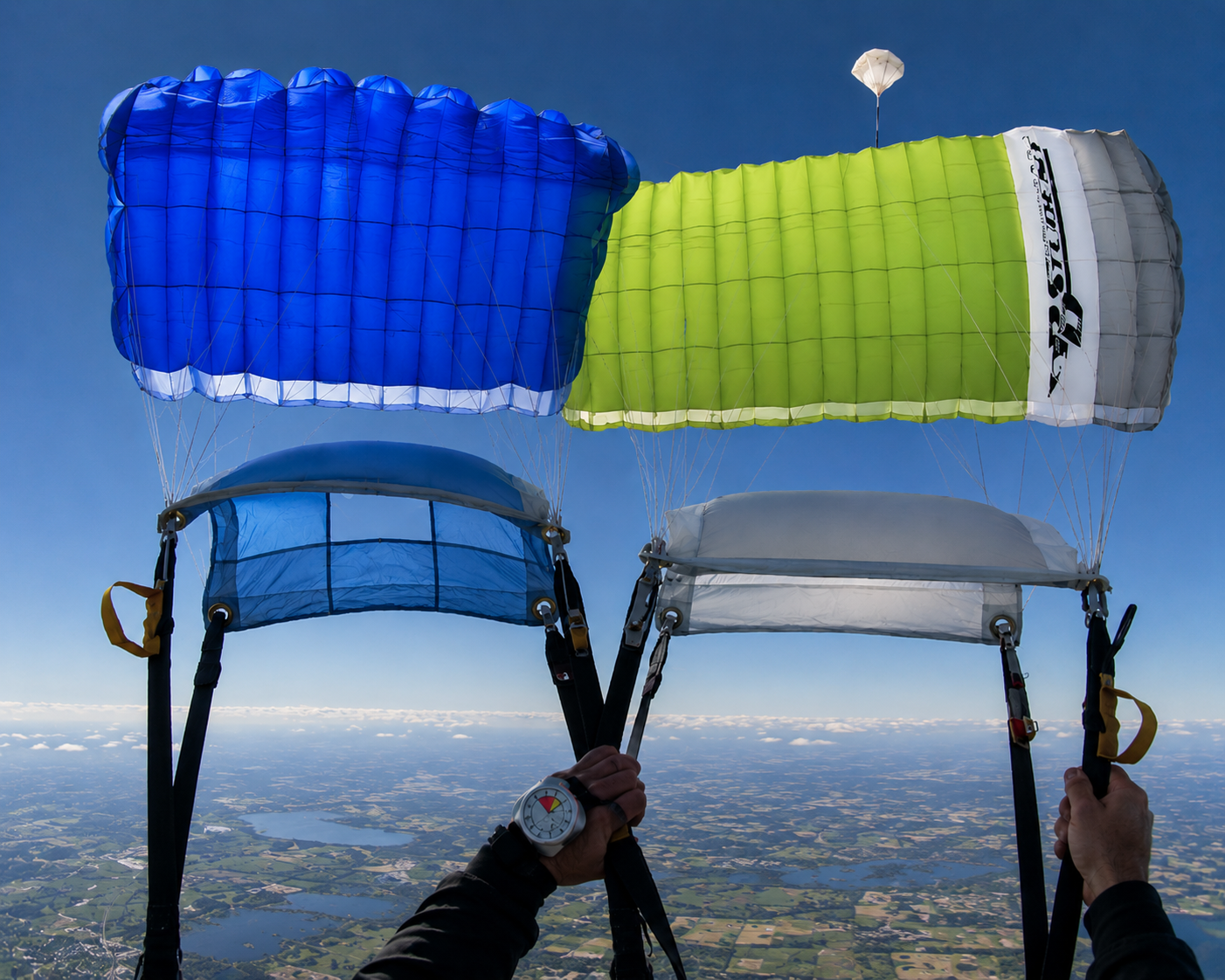
The main parachute and reserve parachute are standing next to each other.
Solution:
If the two parachutes are not entangled and are flying clearly separated, you can choose to detach the main parachute and land safely on the reserve. If they touch, leave the brakes stowed on the smaller parachute. Control the dominant parachute carefully using toggles or the rear risers. Perform a PLF upon landing.
Two canopies out - downplane
Downplane
Solution:
Release the reserve static line and pull the cutaway lever to detach the main parachute. Arch your body to stabilize in freefall, and then pull your reserve lever to open the reserve parachute.
Two canopies out - strangle
Strangle
Solution:
Try to retrieve the least inflated parachute if you have the time and opportunity. Perform a PLF upon landing.
The best advice is to prevent this complex and dangerous situation by properly maintaining your equipment, performing gear checks, remaining height-aware, and pulling in time.
Streamer
You open your parachute and see the canopy above you, but it is not yet fully filled and square.
Solution:
Modern parachutes usually take about five seconds to fully inflate after the opening has been initiated; some take up to ten seconds. Altitude awareness is crucial. If the parachute is not fully open at 2,500 feet, pull the cutaway handle followed by the reserve handle.
Cracked screen & broken lines
You may have a broken line, a tear in the canopy, a pilot chute entangled in the lines, or other damage or abnormalities to the canopy.
Solution:
Use the standard evaluation process:
THERE – SQUARE – STEERABLE!
(Present – Square – Controllable)
Check handling, stability in turns, and flare. If a broken line is a steering line, depending on your experience and knowledge of the glider, you can choose to steer and land using the rear risers instead of disconnecting.
In general, the following applies:
More than one broken carrying line → detach main parachute and use reserve.
A hole large enough to stick your head through or visible light through the bottom of the canopy → detach main parachute and open reserve.
Pilot chut over the nose of the canopy
After opening, your pilot chute flies in front of the front of your parachute and can even get entangled in the lines.
Solution:
Use the standard evaluation process:
THERE – SQUARE – STEERABLE!
Check the controllability, stability, and flare.
Twist
Upon opening, you will notice that the risers and/or lines above your head are rotated. Sometimes you also spin around. With medium performance screens, you may experience heavy spinning, often while the slider is still high in the lines.
Solution:
- If the canopy opens normally without twists but rotates on its own, check that both brakes are released. One toggle may have come loose during opening.
- If the canopy is directly above you and does not dive or spin, pull the risers apart and kick with your legs as if you were on a swing. You can also squeeze the risers together and twist your body out from underneath as if wringing something out. Keep checking your altitude.
- If the canopy spins, dives, and you are not directly below the canopy, pull the cutaway handle and immediately thereafter the spare handle to at least 2,500 feet.