



Procedures
Exit order
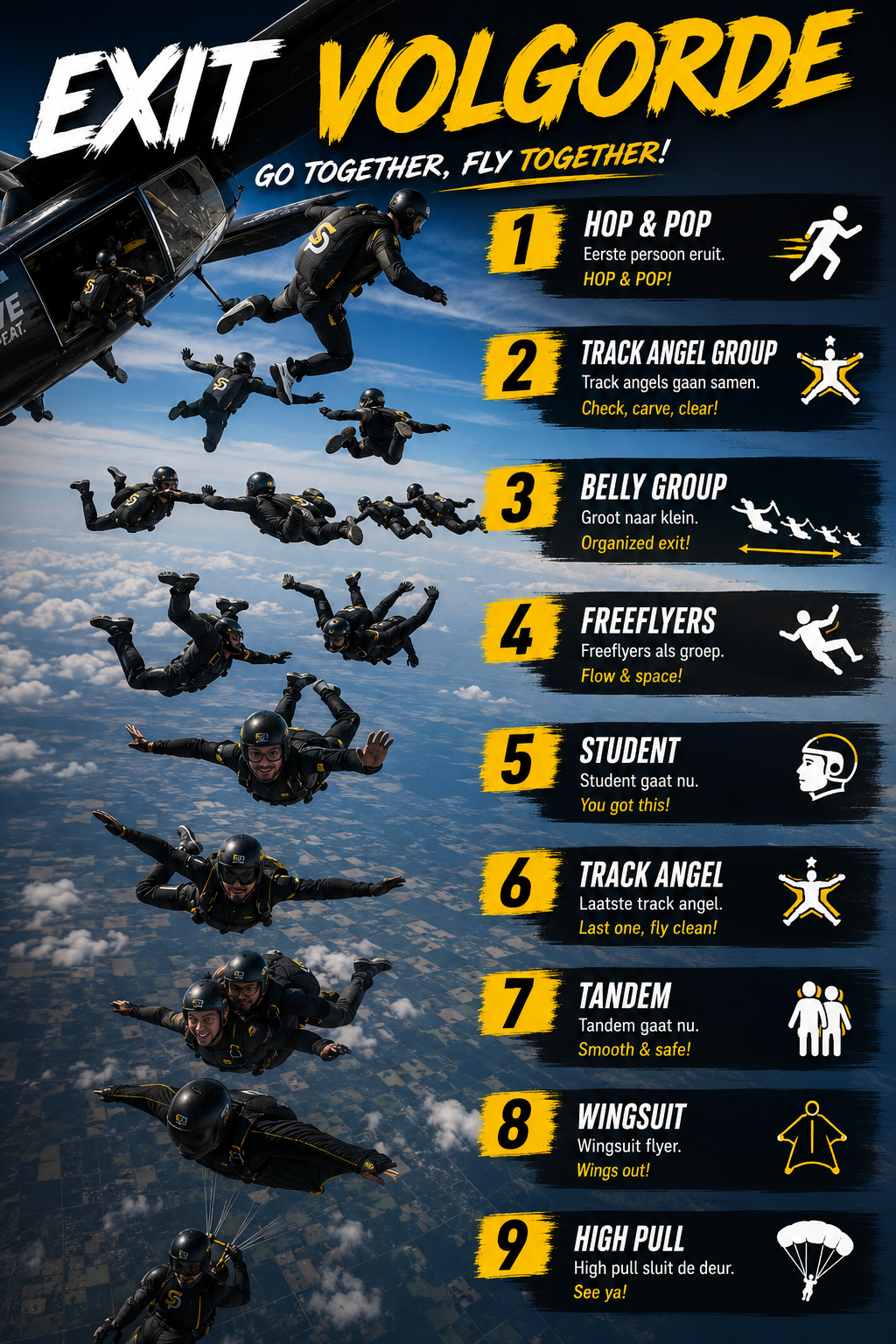
The exit order determines the order in which groups leave the aircraft. This is important to maintain sufficient distance between the groups and prevent dangerous situations in the air. The order is usually determined based on horizontal displacement during freefall and while under parachute. Please note that this may vary by drop zone. Always check with your own drop zone for the specific exit order.
Example of an exit sequence:
1. Canopy Piloting (Hop & Pop)
a. These jumpers open their parachutes almost immediately after exit.
b. Because they fly under the canopy for a long time, they usually take off first.
2. Trackinggroepen / Angle Flying
a. These groups move deliberately horizontally through the air.
b. Therefore, they need more separation and jump later.
3. Formation Skydiving (FS)
a. FS groups fall relatively straight down with little horizontal displacement.
b. Therefore, they leave early in the load.
4. Freefly
a. Freeflyers have higher falling speeds and slightly more horizontal movement.
b. They usually leave the aircraft after FS groups.
5. Students
a. Students have less experience and therefore open higher.
b. This gives them enough room to fly.
6. Trackinggroepen / Angle Flying
a. These groups move deliberately horizontally through the air.
b. Therefore, they need more separation and jump later.
7. Tandems
a. Flying at high altitude at a low speed.
b. To avoid being a nuisance to other jumpers.
8. Wingsuit Flying
a. Wingsuits cover the greatest horizontal distance during free fall.
b. To prevent them from flying towards other groups, they usually leave the aircraft last.
9. High pull
a. High pull flying at high altitude under their canopy.
b. So as not to be a nuisance to others, they jump last.
Why this order?
The purpose of this sequence is to create sufficient distance between all groups, both during freefall and while parachuting. Groups that cover little horizontal distance depart earlier, while disciplines that fly horizontally extensively leave last. This ensures the airspace remains clear and safe for all jumpers.
Spotting
“Spotting” means determining where the aircraft should fly and where the jumpers should disembark, so that they land safely at the correct landing area after the jump.
1. Check the wind at different heights.
The wind determines how far the jumpers will drift during free fall and under the parachute.
2. Determine the landing zone.
Know exactly where you want to end up. Look at landmarks on the ground such as roads, canals, cities, or fields.
3. Calculate or estimate the wind drift.
In strong winds, the aircraft must be further forward of the target area when the jumpers disembark.
4. Does the plane fly the jump run?
The aircraft flies a straight course to the planned drop-off point.
5. Give the exit signal when the aircraft is at the correct point.
Nowadays, spotting is often supported by GPS systems and the pilot, but skydivers still learn how to spot visually in case electronic aids are not available.
Pin check
You perform the pin check on the ground after you have been strapped in. During this, you verify that you are properly strapped in and ready for the jump. You perform this process again in the aircraft at the agreed altitude to ensure that everything is still correctly positioned.
De pin check:
check opening systems
- pilot chut
- spare handle
- drop cushion
check tires
- borstband
- beenbanden
check equipment
- helm
- hoogtemeter
- brilletje